.jpg)



June 29, 2026

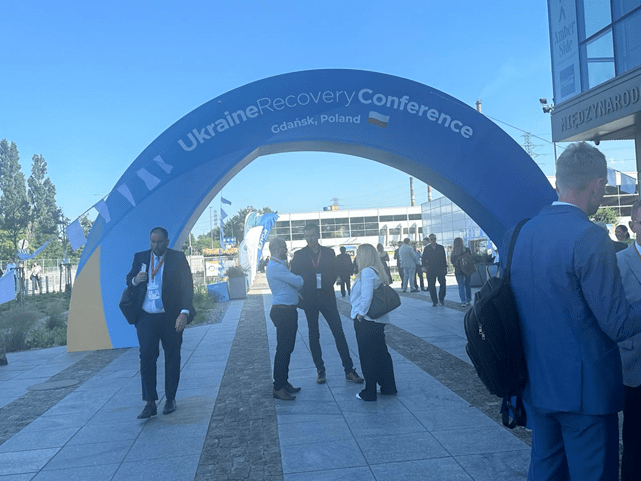
The Ukraine Recovery Conference 2026 (URC-2026), the main international forum dedicated to Ukraine’s recovery, has concluded in Gdansk, Poland. This year’s conference brought together representatives of governments, international financial institutions, businesses, communities, and the professional community to coordinate further steps towards the country’s rebuilding.
For the Interstate Consultants Engineers Guild, not only the announced financial decisions are of particular value, but also the shift in the international approach to Ukraine’s reconstruction.
While previous conferences primarily served as a platform for assessing the needs, mobilizing international support, and forming financial mechanisms, this year’s URC marked the transition to a new stage – practical implementation of projects, development of partnerships, and engagement of private investment.
The forum’s outcome confirms the same. The Ukrainian delegation reported preparations for the signing of more than 160 agreements with a total expected value exceeding EUR 10 billion. During the conference itself, an agreement worth USD 3.39 billion was signed with the World Bank, and the European Union announced the disbursement of the first tranche of a new credit facility amounting to EUR 3.2 billion. In addition, new investment instruments were presented, aimed at engaging private capital in Ukraine’s reconstruction more actively.
Importantly, the content of the discussions has also changed. Alongside financing issues, considerable attention was given to the preparation of high-quality projects, development of public-private partnerships, war risk insurance, community modernization, development of municipal infrastructure, and the alignment of reconstruction processes with European reforms. These are the areas that the Ukrainian side prioritized at the conference.
This is an important signal for the engineering consultancy sector. Large-scale reconstruction will increasingly need not only financial resources, but also high-quality project preparation, professional management of implementation, effective coordination among participants, and application of modern international practices.
That is why, alongside financing issues, the institutional capacity of public contracting authorities, communities, and professionals to ensure the delivery of complex infrastructure programs is becoming ever more important.
For ICEG, the outcomes of URC-2026 provide another confirmation that the international agenda is gradually shifting from discussing the needs to the practical implementation of projects. In these conditions, development of professional competencies, international cooperation, and modern approaches to project management is becoming one of the key factors for the successful reconstruction of Ukraine.
