.jpg)




August 14, 2026
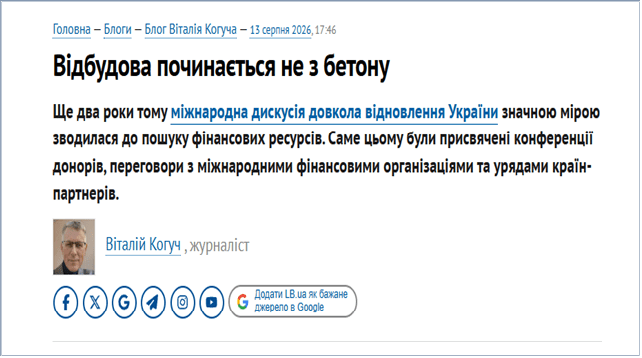
LB.ua has published an article titled “Reconstruction does not start with concrete: Who should manage complex infrastructure projects?”, dedicated to one of the key issues in the next stage of Ukraine’s recovery—who should integrate a complex infrastructure project into a single manageable system and be responsible for the integrity of its implementation process.
Ukraine is talking a lot about the capacity of local communities, shortage of specialists, funding, and the need for high-quality project preparation. But as the scale of reconstruction grows, the next question arises: What happens when a client, designer, contractor, construction supervisor, consultants, donors, and financial institutions are all working in the same project simultaneously?
Having all the necessary specialists does not mean having management.
This is the focus of the new material. Its central topic is the transition from discussing individual competencies to the integrated management of complex infrastructure projects.
In international practice, various professional models can perform this integrating function, e.g., Project Management, Engineer, Contract Engineer, and other project management mechanisms. Their task is not to replace the client, designer, or contractor, but to ensure the process coordination, contract administration, management of variations, timelines, risks, and interaction among all participants.
Special attention in the article is given to the institution of the consulting engineer.
For Ukraine, this is neither a new nor an experimental concept. The institution of the consulting engineer is already legislated and can be used by clients during the implementation of construction and infrastructure projects. At the same time, its potential is not currently utilized to the full.
This practice becomes particularly significant in large projects with international financing, where requirements for professional management, contract procedures, allocation of responsibility, and risk control is an integral part of the project architecture itself.
The article examines this problem not only from the perspective of the professional engineering community. Representatives of local government and Ukrainian and international experts are involved in the discussion, allowing for a multi-faceted look at the reconstruction management.
For the Interstate Consultants Engineers Guild, this discussion is part of a broader effort to develop modern mechanisms for implementing infrastructure projects in Ukraine.
The scale of reconstruction is gradually changing the very question the state must ask itself. It is no longer enough to ask where to find money, specialists, or a contractor. Another question is becoming increasingly important: Who and how will manage the entire project implementation system — from preparation to commissioning.
And this conversation is only beginning.
After all, the next question is even more difficult: How exactly should such models work in Ukrainian conditions, what prevents the full use of existing professional tools, and what safeguards are needed to ensure that new opportunities do not create new risks?
It is this direction of continued discussion that ICEG calls for.
